Heard in the Hush: Why the Quiet Bits in Your Recordings Sound Less Real Than the Loud Ones
Here's something that'll mess with your head a bit: the loudest, most chaotic moment in your track — the full band crash, the wall of guitars, the snare hitting like a door slamming — probably sounds more convincing than the quiet breath before it. That single piano note. The vocal that drops to almost nothing. The space between the words.
Why? Because silence, or near-silence, is one of the hardest things to fake. And in a UK home studio — whether that's a converted spare room in Manchester, a garden shed in Bristol, or a box room in East London — you're fighting a battle on multiple fronts every time you try to capture it.
The Noise Floor You've Learned to Ignore
Every recording environment has a noise floor — the ambient hum of everything that isn't your music. In a professional studio, that floor is engineered to be extraordinarily low. In your home, it's... not.
You've probably stopped noticing most of it. The faint whir of a boiler. The low-frequency rumble of traffic on a nearby A-road. The central heating ticking on. The neighbour's telly bleeding through the party wall. These sounds sit beneath your conscious awareness when you're tracking, but they don't sit beneath your microphone.
When your vocalist belts a chorus, none of that matters — the signal is loud, the transients are dramatic, and the background noise is simply buried. But the moment they pull back to a whisper, or a guitarist plays a single fingerpicked note with space around it, the noise floor crawls up into the foreground. Suddenly, your intimate moment sounds like it was recorded in a hallway. Because, in a sense, it was.
This is uniquely frustrating in the UK, where older housing stock means thinner walls, shared chimneys acting as acoustic conduits, and the general ambient noise of densely packed towns and cities seeping in constantly. A semi-detached in Coventry is not a recording studio, no matter how much foam you've stuck to the walls.
The Compression Trap
Here's where a lot of home recordists make things worse without realising it. You've recorded a quiet section, you can hear the noise floor creeping in, so you reach for a compressor to even things out and bring up the level. Makes sense, right?
Except what you're actually doing is raising the noise floor with the signal. The compressor doesn't know the difference between your vocalist's breath and the hum of the 73 bus going past outside. It brings everything up together. Now your quiet passage doesn't just sound noisy — it sounds artificially noisy, in that telltale squashed way that immediately signals "home recording" to anyone who's spent time around professional audio.
Over-compression on quiet sections is one of the most common tells in home-produced music. The dynamic range that should make a soft moment feel intimate and vulnerable instead gets squashed into a kind of nervous, unnatural flatness. The very thing you were trying to fix makes it sound faker.
What Sparse Arrangements Actually Demand
There's a reason producers say that minimalist arrangements are harder to pull off than dense ones. When you've got a full mix running — bass, drums, guitars, keys, vocals, maybe a string pad — any individual imperfection gets masked. The psychoacoustic complexity of that many simultaneous sounds means your ears and brain are doing a huge amount of work just to process it all, and small issues slip through unnoticed.
Strip that back to a single vocal and an acoustic guitar, and every flaw is on display. Every tiny room reflection. Every creak of a chair. Every slight inconsistency in mic placement between takes. The arrangement isn't hiding anything — it's a spotlight pointed directly at your room.
This is why so many home recordists find that their "big" productions sound relatively polished, while their stripped-back, emotional recordings feel strangely hollow or unconvincing. The problem isn't your performance. It's that your room simply isn't equipped for that level of scrutiny.
Practical Things You Can Actually Do
Sort your room before you worry about your signal chain. No amount of noise reduction plug-ins will fully fix a bad acoustic environment. Before a quiet session, turn off anything that makes noise — boiler timer, fan heater, desktop computer if you can run your DAW from a laptop. Close windows, obviously, but also think about when you're recording. Early morning or late evening tends to mean less traffic, fewer delivery vans, less general human activity outside.
Get closer to the microphone. This sounds obvious, but it's transformative for quiet recordings. The closer your source is to the mic, the better the signal-to-noise ratio — meaning your voice or instrument is proportionally louder relative to the room noise. A large-diaphragm condenser a foot away from a whispering vocalist will pick up far more room than the same mic six inches away. Proximity also adds warmth and intimacy, which is usually exactly what a quiet passage needs anyway.
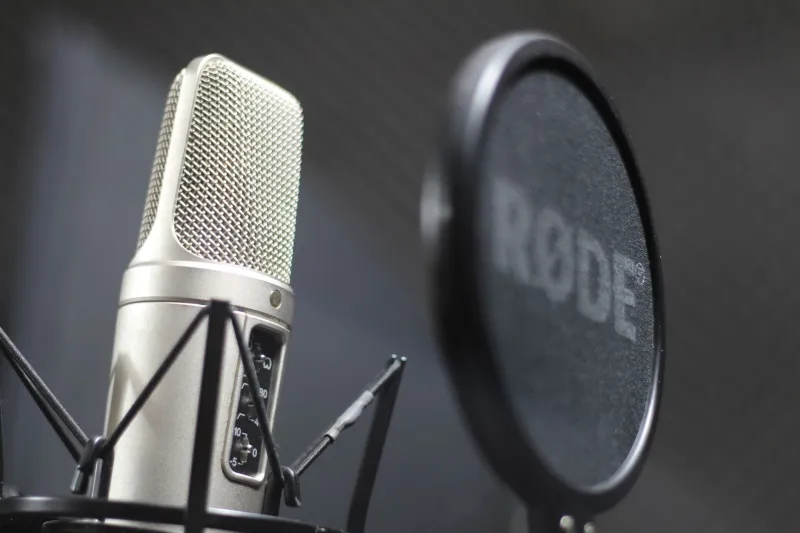
Use a reflection filter or build a DIY vocal booth. A portable reflection filter (the curved foam shield that sits behind your mic) makes a real difference for vocals and acoustic instruments in untreated rooms. If you want to go further, a makeshift booth built from duvets and moving blankets hung on a clothes rail can dramatically reduce room reflections during quiet takes. It's not glamorous, but it genuinely works.
Automate your noise reduction rather than applying it globally. If you're using something like iZotope RX or even the basic noise reduction in your DAW, apply it selectively to the quiet sections rather than across the whole track. This means the tonal character of the recording stays consistent during louder moments, and you're only treating the parts where the noise floor is actually a problem.
Rethink your compression approach for quiet sections. Rather than compressing quiet passages to bring them up, try automating the gain of the track to lift the level before it hits any compression. This way, you're raising the signal, not the noise floor. Use a gentle upward expander instead of a compressor — it's designed to reduce the level of sounds below a threshold rather than crushing everything above one.
Embrace a little noise. This sounds counterintuitive, but sometimes a small amount of room tone actually makes a quiet recording feel more real, not less. A completely dead, noise-reduced, artificially silent quiet passage can sound clinical and strange — like it was recorded in a vacuum. A touch of room, handled tastefully, can add the sense of physical space that tells a listener "this is a real moment in a real place."
The Bigger Picture
The quiet bits in your music carry enormous emotional weight. They're the moments where a listener leans in, where the tension builds, where the performance breathes. Getting them right matters more than almost anything else in your recording — and they're genuinely one of the most technically demanding things to capture well in a home environment.
The good news is that understanding why they're hard is most of the battle. Once you know you're fighting a noise floor, a room, and a psychological reflex to over-process, you can start making smarter decisions at every stage — from the time of day you record to how you treat the signal in the mix.
The silence in your music deserves as much care as the sound. Give it that, and the hush will hit as hard as the crash.